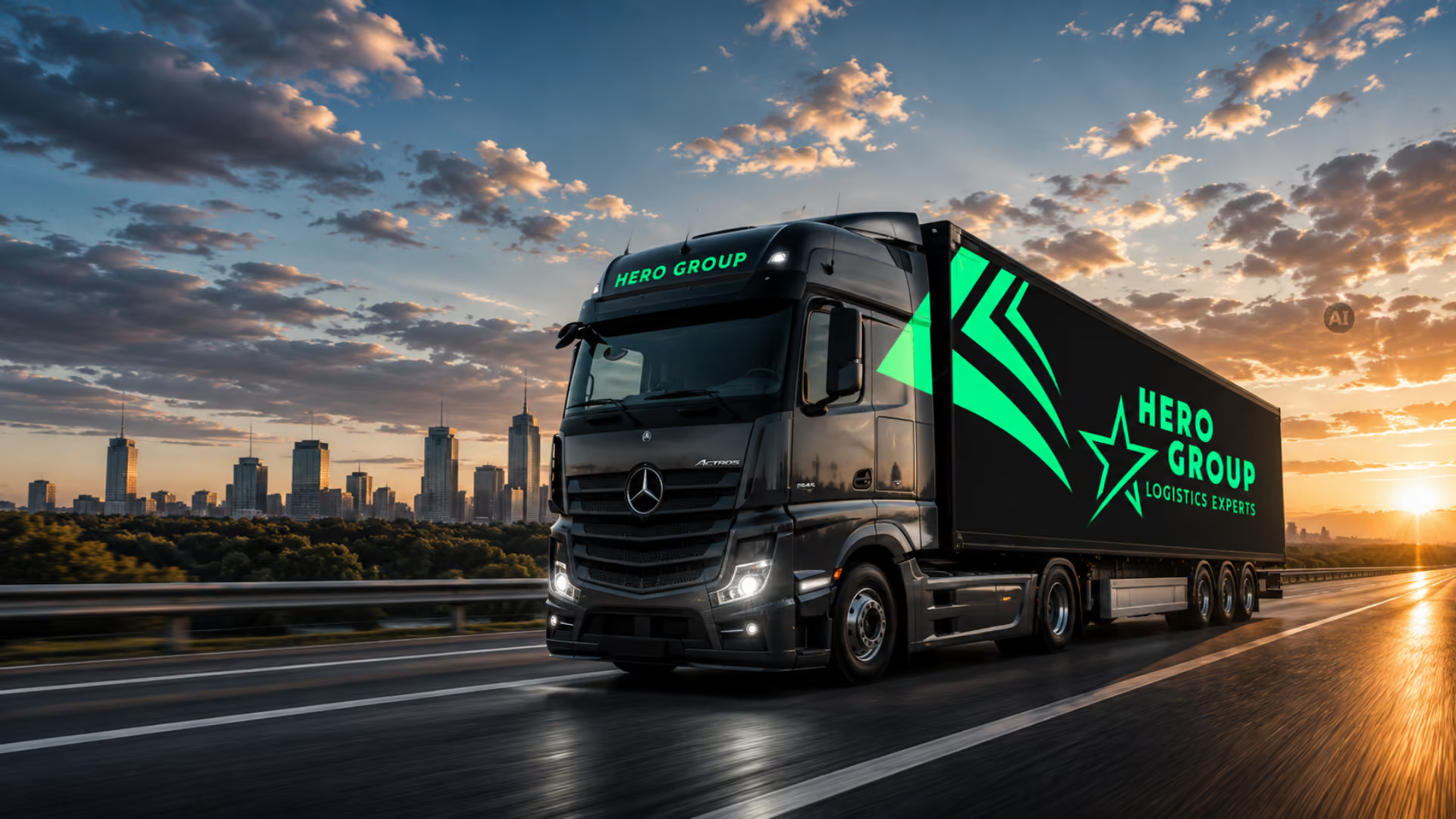
In-house cross-dock network

Cross-docking

With cross-docking, goods move directly from the inbound to the outbound truck at the transshipment point – without any intermediate storage. Instead of goods receipt, storage, picking, and retrieval, there is only a single work step. This reduces storage costs and shortens lead times from days to hours.
7 company-owned locations
4 fixed routes
In-house mega-trailer fleet
Two HERO GROUP employees checking shipping documents at the loading ramp
Symbolic image: Truck at the cross-dock

How cross-docking works

The difference compared to a traditional warehouse lies in what is missing: storage. The goods remain in motion and typically leave the transshipment point on the same day.
Step 01

Delivery

Inbound trucks unload at the dock. The goods are scanned and checked, but remain in the transshipment area – they do not go into storage.
Step 02

Transshipment and sorting

Shipments are sorted by destination route and assembled for onward transport. Pallet exchange, repacking, and labeling take place during this step.
Step 03

Onward loading

The sorted goods are loaded directly onto the outbound truck for the respective route. With fixed departures, the departure time is already set in advance.

Single-stage or two-stage

The right method depends on how far the goods have already been prepared by the shipper.

Single-stage cross-docking

Goods are already picked for the end recipient by the shipper and are simply reloaded at the transshipment point. This is the fastest method, but it requires meticulous preparation and correct labeling.

Two-stage cross-docking

Goods arrive as a consolidated shipment and are redistributed by recipient at the transshipment point. While handling is more complex, it allows quantities from multiple sources to be bundled into a single load.

multi-stage cross-docking

For more complex supply chains, multi-stage cross-docking can also be a practical solution. In this process, shipments pass through several coordinated transshipment points before reaching their final destination. This can be particularly useful for supra-regional or international goods flows.

When cross-docking pays off – and when it doesn't

Cross-docking is not a replacement for a warehouse, but an alternative for specific goods flows. An honest assessment saves more money than any optimization within the wrong concept.

Suitable for

High-turnover goods with predictable demand
Perishable or temperature-controlled goods
Shipments consolidated from multiple sources to a single recipient
Routes with fixed, recurring departures
Branch and factory supply with fixed time windows

Better to store traditionally

Highly fluctuating or seasonal demand
Goods that must be kept as safety stock
Small quantities without regular call-offs
Items with long lead times
Assortments that require assembly before shipping
Rent warehouse space – 100,000 m² at 7 locations
Fixed departures

Our cross-dock network

The HERO GROUP operates its own transshipment points at seven locations in Germany, Poland, Hungary, and Romania. Our main routes run on a fixed schedule – you can plan based on a firm date, not just a promise.
Route
Frequency
Transport type
Germany – Hungary
3× weekly
Part and full loads, own facility in Mosonmagyaróvár
Germany – Romania
3× weekly
Part and full loads, own location in Sura Mică near Sibiu
Paderborn – Munich
daily
Transshipment at the Bergkirchen cross-dock, connection to Southern Germany
Paderborn – Leipzig / Dresden
daily
Transshipment at the Großweitzschen cross-dock, connection to Saxony

In-house mega trailer fleet

Transshipment is of little use if you lack the right trailer. The HERO GROUP handles routes with its own fleet of mega trailers: more volume per trip within the same weight limit. For lightweight, bulky goods, this noticeably reduces the cost per pallet space.
View all transport logistics services
HERO GROUP mega trailer on the highway
HERO GROUP mega trailer on the motorway

IT integration and transparent goods flows

Efficient cross-docking requires not only short distances within the warehouse, but also a reliable flow of information. Transport data, shipment details, and time slots must be coordinated between the shipper, the transshipment point, and the recipient. Depending on the project, existing digital processes and interfaces can be integrated into the operational workflow. We will work with you during the project planning phase to determine which technical integration is practical and feasible for your goods flow.

Fixed departures instead of waiting?

Request a transport quote now

faqs

Welcome to the HERO GROUP FAQ section.

Here you can quickly and easily find answers to the most frequently asked questions about our transport services, safety standards and day-to-day business processes.

What is transport logistics?

Transport logistics is the branch of logistics that deals with

What types of transport does the

As a specialized logistics service provider, HEROG ROUP offers comprehensive transport solutions, primarily in

What is the difference between single-stage and two-stage cross-docking?

In single-stage cross-docking, the goods are already picked for the end recipient at the sender's site and are simply reloaded. In two-stage cross-docking, goods arrive as a consolidated shipment and are redistributed by recipient at the transshipment point.

What does "cross-docked" mean?

"Cross-docked" describes a shipment that has passed through a transshipment point without being stored there. In tracking systems, the term appears as a status update indicating that the transshipment has been completed.

What are the benefits of cross-docking?

Shorter lead times, lower warehousing costs, fewer handling steps, and consequently a lower risk of damage. With fixed departures, you also gain predictability: the departure day is set in advance.

How much does cross-docking cost?

The price depends on the route, shipment size, frequency, and handling requirements. Since there is no need for storage, warehousing costs are lower than with traditional storage—however, this requires a regular, predictable volume. We calculate costs per route.